 Is OOP in PHP going to Help in Other Languages?
PHP is a great tool for working with both Web-based languages like HTML5, JavaScript, CSS3 and jQuery (actually a kind of JavaScript). Of course it’s an essential tool for working with SQL and the kinds of server-side operations that can only be done with a server-side language like PHP.
With the advent of mobile devices, PHP developers are able to add to help recognize devices through user-agents, but sniffers are plagued by both the vague information provided by the user-agents and may not be able to tell the difference between different screen widths and resolutions with the same user-agent information; like iPads and iPad Minis. Microsoft has the same user-agent id for all of their devices–“trident.”
Web Apps and Device Apps
PHP has been a great tool in Web app (applications that run in a browser) development for mobile devices, but these apps are largely dependent on an Internet connection, and unless there’s some way to add a local host to an Android-based Note or iOS-based iPhone, you rely on a connection to the Web. Even with WiFi being widely and generally available, an app that runs on the native Android OS or the Apple iOS (Device App) has lots of advantages over a Web app.
Don’t get me wrong. Web apps have tons of advantages over device apps when it comes to development and distribution. All devices that have browsers can run Web apps, but apps made for an Android will not run on iOS devices and vice versa.
So if you know PHP (and lots of other Internet languages), at some point you may have to bite the bullet and download the (free) Android and/or iOS SDK (Software Development Kit). The good news is that if you’ve been working with PHP OOP and design patterns, much of the code environment will look very familiar. The IDEs used by both the Android and iOS SDKs are very similar. The development process, though, takes place within classes and structures that you will be familiar with—depending on how much you’ve been experimenting with PHP OOP and design patterns.
For example, the following is a simple Swift class that generates a message—not too dissimilar from what JavaScript does with an alert() function.
import UIKit

class ViewController: UIViewController
{
    @IBAction func showAlert()
    {
        let alert = UIAlertController(title: "Sandlight Productions, LLC",
            message: "Messages for the World!",
            preferredStyle: .Alert)

        let action = UIAlertAction(title: "Sandlight", style: .Default, handler: nil)

        alert.addAction(action)

        presentViewController(alert, animated: true, completion: nil)
    }

}
|
Both the Android and iOS SDKs have lots of importable classes, and the imported UIKit has objects for the UI. The class declaration,
class ViewController: UIViewController
would be like declaring
class ViewController implements UIViewController
in PHP. So, while some different operators are used (e.g., : instead of implements) most of the statements are pretty close to those in PHP.
Some, though, are special to both the framework and the language. For instance,
@IBAction func showAlert()
does not have an equivalent in PHP for the whole method. The @IBAction connects the source code to a UI object. The showAlert() method, in this example, is connected to a button in the Interface Builder, part of the iOS SDK. Further, func is used instead of function used in PHP.
In declaring variables, Swift, uses the let keyword and the = assignment operator, and Swift does not use the new keyword in creating objects. For example, in Swift,
let alert = UIAlertController(//parameter list);
would be,
$alert = new UIAlertController(//parameter list);
in PHP. If you understand something about OOP and design patterns, this other type of programming makes more sense than if you do not.
Figure 1 shows the output on a simulator developed in the iOS SDK:
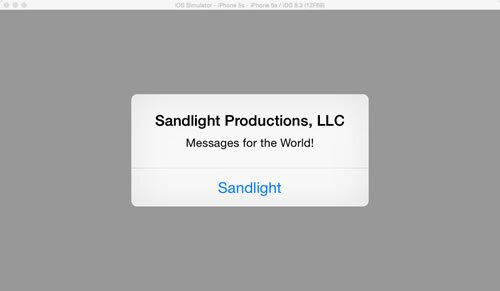
Figure 1: Landscape view of the alert in an iPhone 5s simulator.
In and of itself, it’s no great shakes. However, it can be run anywhere and without a browser or an Internet connection. What’s important is that those working with OOP and design patterns in PHP are far closer to the languages used for Android (Java) and iOS (Swift). So if you start getting clients who demand to have their own apps to be downloaded to their phones and used without a browser, don’t be afraid to start making some simple ones. You can even create a device app that calls up a mobile app written in PHP and jQuery Mobile. The big advantage of that is you can access an SQL database.
Event Driven Programs and Programming: Not So Much PHP
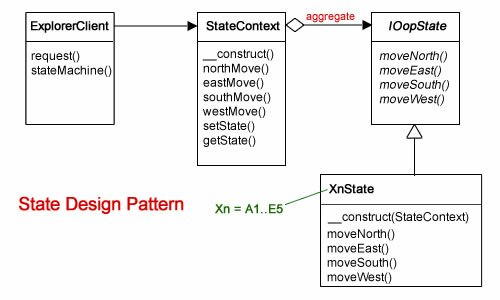
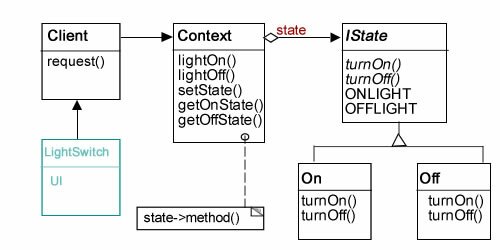
If you’ve ever made a game—especially the arcade type—you’re probably familiar with “event-driven programming.” Languages like ActionScript, including OOP and design pattern designs, used to be used a lot in event-driven software development. The State design pattern is often used for event-driven programs since the states keep changing with new information from the user. The events are typically made up by the user tapping, sliding and dragging objects on the screen. PHP at some base is more of a data-getting and setting type of software. The getting and setting is done in conjunction with MySQL and the SQL language.
A lot of mobile app development is done with event-driven processes, and at least in the SDKs for iOS and Android, the frameworks are set up in classes and more state-like programming than you’ll see in most PHP. However, on this blog, the Client-Request model is easily applicable to event-driven kinds of applications. A number of PHP programmers have some interesting suggestions for event-driven programming and programs, but I’m not sure how well they’d work compared to languages like Python where the connections to the event-producing object (e.g., mouse/finger clicks/taps and keyboard entries) are more direct. PHP is a bit too dependent on HTML and JavaScript to handle events in client-side events.
In any event, using OOP and design patterns in PHP is very transferrable to other languages. The same is true in using the logic and structure of functional programming. So, if you’re thinking about jumping into either iOS or Android app development, you’ve be entering a familiar programming environment if you understand working with OOP and design patterns in PHP. Don’t be afraid of event-driven programs even though they’re not exactly common in PHP. The structures you will work in will be very familiar.
 I was invited to speak at on April 22 at Microsoft’s NERD Center in Boston for Month 4 of Boston PHP’s 200 Days of Code. The Advanced track of 200 Days of Coding is going through Larry Ullman’s book, PHP Advanced & OO Programming (3rd ed), and I’ll be talking about materials from Chapters 8-10. However, with a little over an hour, I am using Occam’s razor to keep things focused, pertinent and related to the relevant chapters. Chapter 10 is about Networking with PHP, and by way of preview, I thought I’d take the material that Larry has on geolocation, and put it into an OOP structure using the Template Method design pattern. I also made a number of other modifications for which Larry cannot be blamed! Go ahead and Play the program to see what it does and Download the code. (The text window defaults to sandlight.com but you can add any URL you want.)


 PHP Game Mechanics
 For the last ten weeks I’ve been learning functional programming and Haskell through an edX
 Immutable


Recent Comments